
What was consulted?
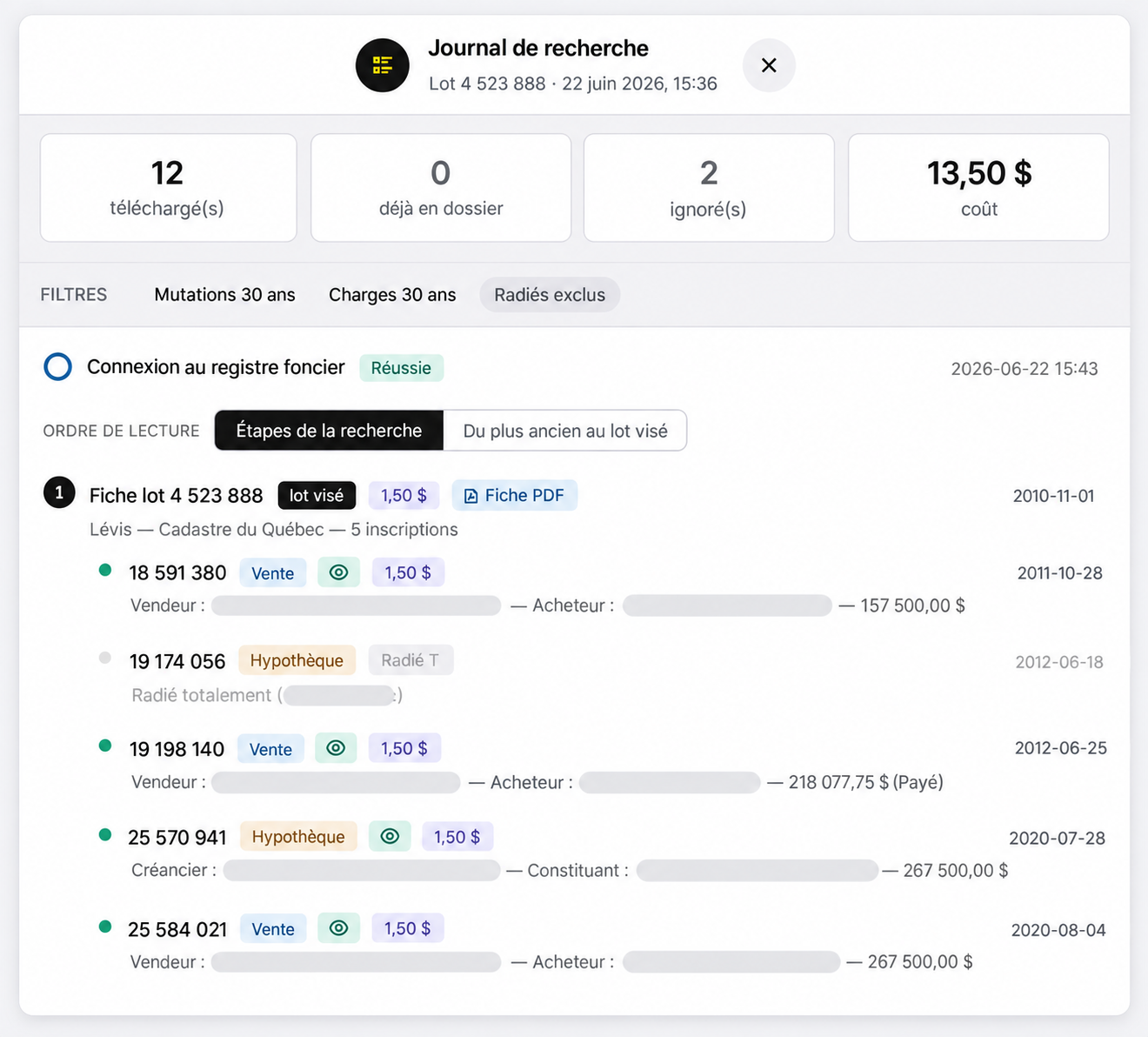
The execution log lists every index and every deed the agent opened in the registry — not only what it kept from them.

Every conclusion traces back to its document. Every search leaves its trail. Every item that couldn't be obtained is declared.
30 free credits. No credit card required.


The standard of notarial intelligence
A clean interface, designed to assist professionals without replacing their judgment.
In a title examination, the risk isn't in what you read. It's in what wasn't consulted, in the chain that breaks without saying so, in the deed that couldn't be obtained. An omission doesn't announce itself the same day — it surfaces years later, in a third party's hands.
What wasn't consulted appears nowhere. Without a record of what was opened, there's no way to know what was omitted.
A lineage that couldn't be traced all the way back looks, from a distance, like a complete chain. The difference has to be stated.
A deed that couldn't be obtained leaves no trace — unless the tool declares it, counts it, and shows it.
A title examination is judged by what can be retraced. Here are the questions NotairIA answers by showing its work.
The execution log lists every index and every deed the agent opened in the registry — not only what it kept from them.
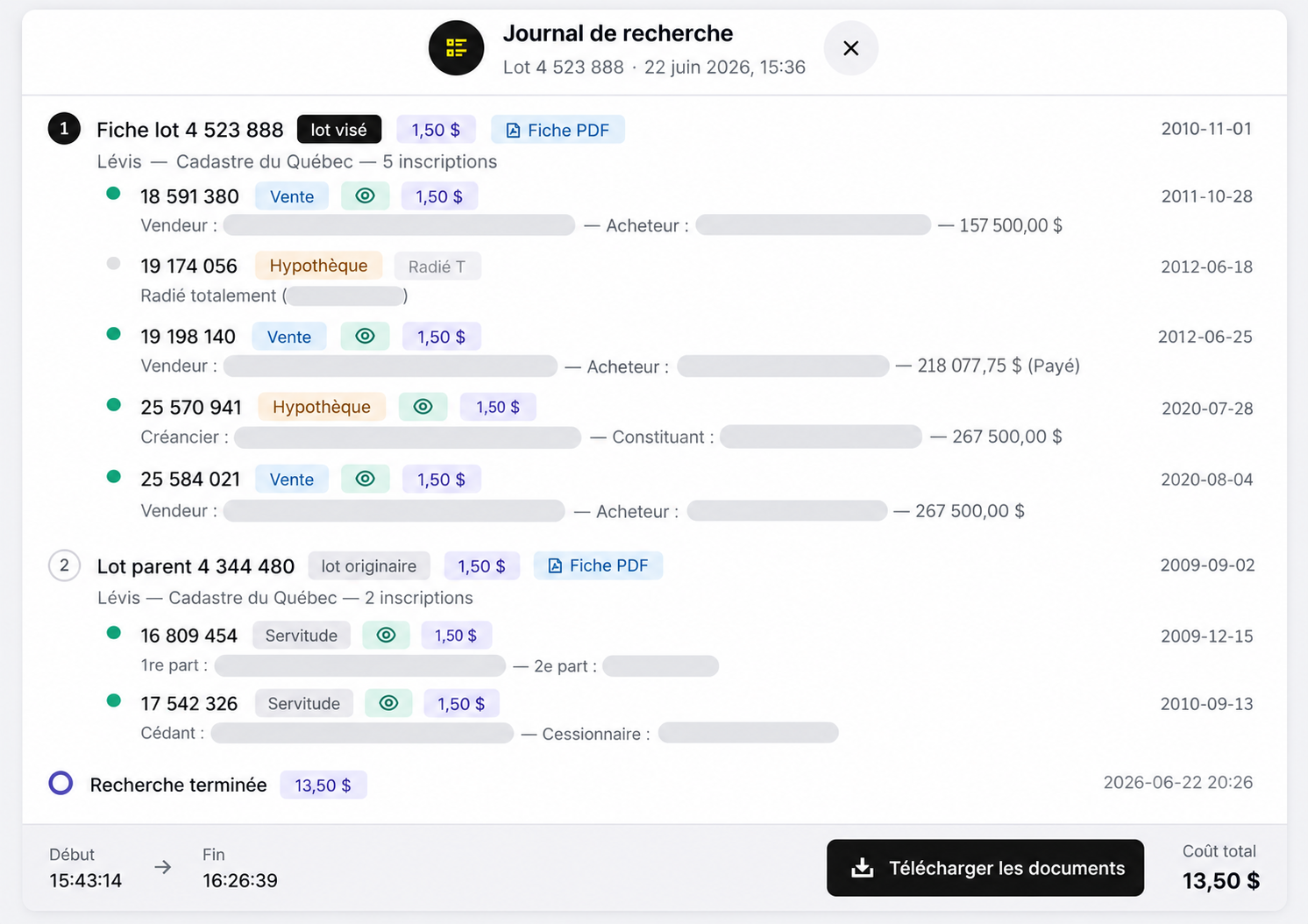
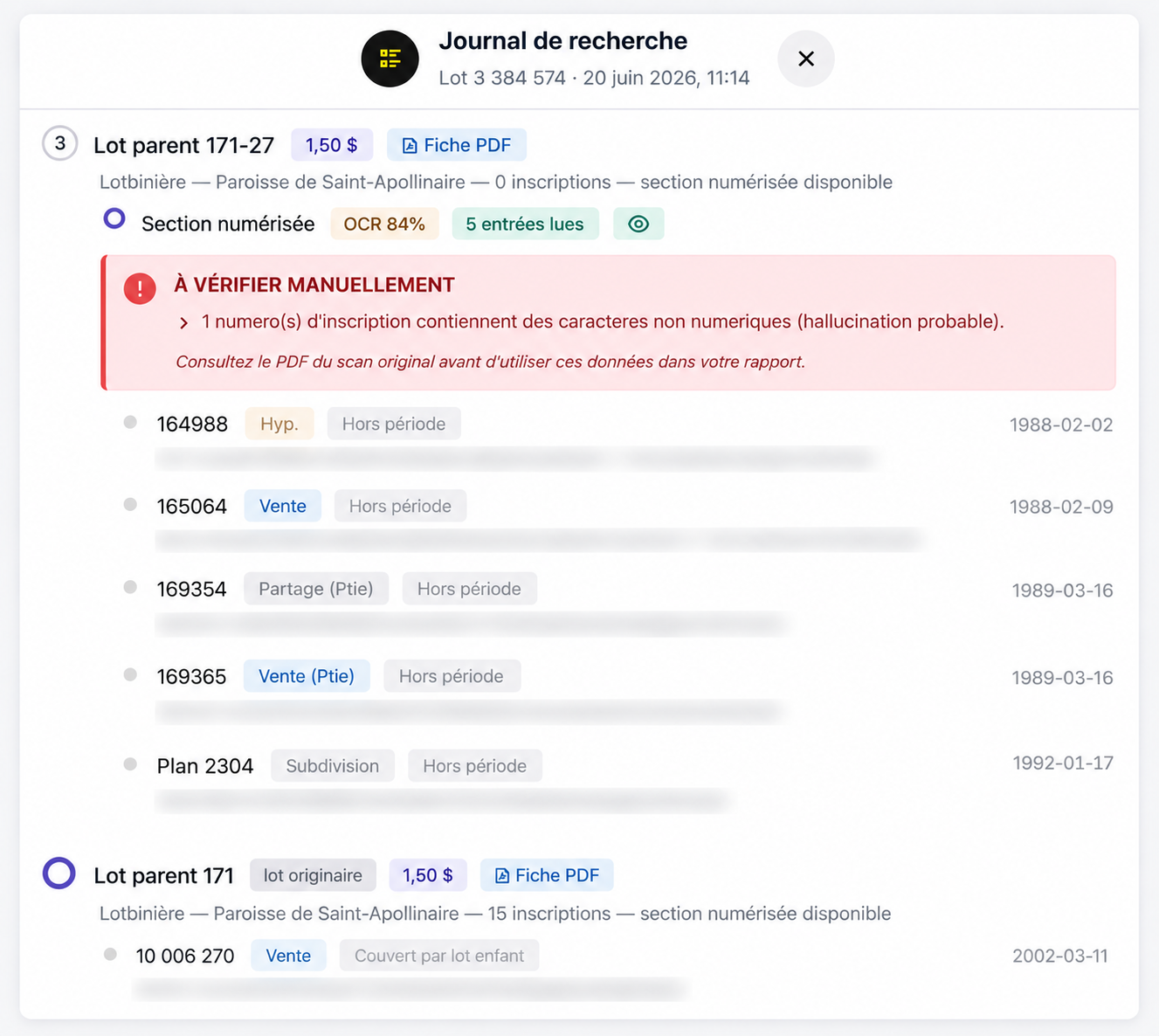
The lot's lineage is followed through cadastral renovations back to the original lot, and every lot encountered along the way is named.
The items the agent couldn't obtain are declared and counted, never passed over in silence.
Registrations are kept according to the transfer and encumbrance periods you set; the log also shows what was set aside.
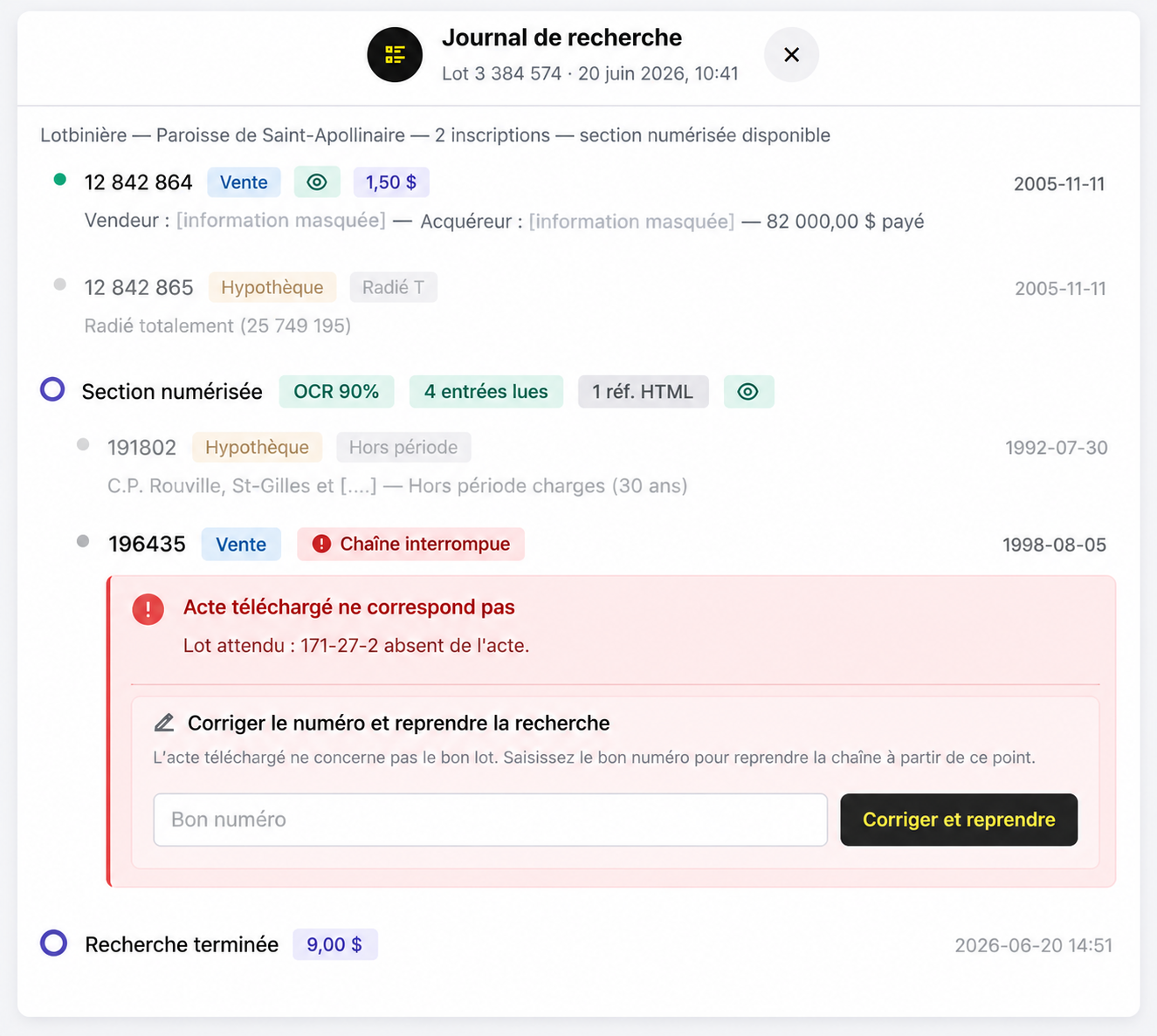
When the lineage can't be traced all the way back, the search is flagged as incomplete rather than presented as continuous.
In conversation, every answer about the file points to the documents that support it, which you open with a single click.
NotairIA doesn't ask to be believed. It shows what it did, where its results come from, and what remains to be established.
Consulted, kept, set aside, not obtained: every search keeps a record of its path, openable line by line.
Every reported deed stays tied to its origin in the registry, verifiable in one click rather than on trust.
An incomplete search is named as such and what's missing is counted — so that verification is targeted, not doubled.
From the target lot to the original lot: every registration consulted, kept, or set aside, time-stamped, with the real cost of the search.
A broken chain or an uncertain reading is named and located — never blended into a clean-looking result.
Consultations are carried out under your firm's account. The trail stays yours.
“If the AI gets it wrong, I'm the one who pays.”
True — and that's exactly why the product is built this way. A tool that hides its uncertainties leaves you responsible for an error you couldn't see. NotairIA makes every element inspectable and declares what it couldn't obtain, so that verification is targeted rather than doubled: three points to check, instead of a hundred to re-check.
NotairIA didn't start from a software spec. It was born of a question of trust.
On one side, nearly twenty years of notarial practice: knowledge of the field, title examinations that don't always follow a straight line, concordances to reconstruct, chains that break, and those details that — when they slip past the examination — can have very real consequences.
On the other, university research on trust technologies and traceability applied to the notarial profession and to smart contracts, around a fundamental question: how can you demonstrate what was done, on what basis, and let a third party verify it?
These two perspectives shaped NotairIA.
That's why the product doesn't merely deliver a result. It keeps the path that leads there: the sources consulted, the deeds reported, the items retained, those that couldn't be established, and the trail needed to return to the origin of a piece of information.
Traceability wasn't added to NotairIA to inspire trust. NotairIA was built from it.
30 free credits on sign-up, no credit card. Enough to judge for yourself.
Create my account